Published 2026-10-12
Can a Cheap VPS Hit You With a Surprise Bill? A Q&A on Fixed Prices, Hourly Billing, and Hard Spend Limits
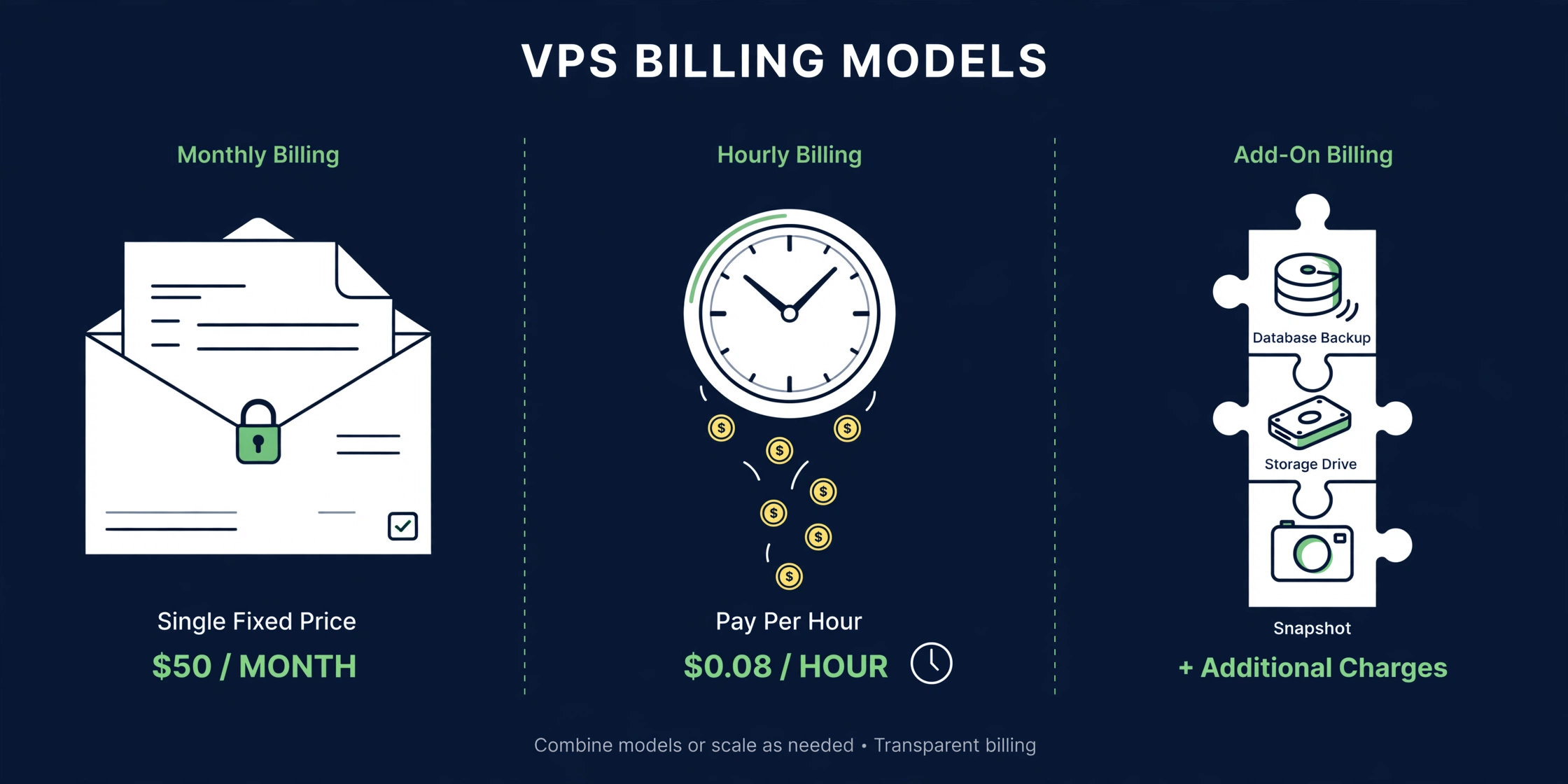
Short answer: on a fixed monthly plan, no — the number on the pricing card is your bill. Surprise bills come from exactly three places: hourly/metered billing (the clock keeps running after you forget the server exists), metered extras (storage add-ons, snapshots, backups), and bandwidth overage where the provider charges per gigabyte. In our 2026-10-11 snapshot of 191 live offers across 32 providers, scraped from official pricing pages, 17 rows are sub-dollar metered/hourly lines — that is the entire surface where a bill can move. The other 174 are flat monthly figures.
In this guide
- Q: What is the difference between fixed monthly and hourly billing?
- Q: If I stop or power off my server, does it still bill?
- Q: Can a traffic spike or a DDoS attack inflate my VPS bill?
- Q: Do backups and snapshots cost extra?
- Q: Is there a hard spend limit — can I cap what I pay, ever?
- Our take: the no-surprise-bill setup
| Billing surface | Can the bill exceed the headline? | Seen in our 2026-10-11 snapshot |
|---|---|---|
| Fixed monthly plan | No — the plan charge is fixed | 174 of 191 rows (median $14.55/mo across 182 USD rows) |
| Hourly / per-second | Yes — up to the plan's monthly cap | Kamatera $0.01/hr, Liquid Web hourly rows, CloudCone hourly rows, DigitalOcean per-second rows |
| Metered extras (storage, snapshots, backups) | Yes — excluded from the headline | DigitalOcean "Backups … Starting" $15/mo row, Cherry Servers storage add-on $0.07, DreamHost "AWS Lightsail Metered" rows |
Snapshot: 2026-10-11, 191 offers / 32 providers, prices as listed on official pricing pages. "Sub-dollar metered lines" = the 17 rows under $1 that price by the hour, second, or gigabyte rather than by the month.
Q: What is the difference between fixed monthly and hourly billing?
A fixed monthly plan rents you a slice of server for the calendar month. You pay the number on the card whether you use the server for one hour or 730. Hourly billing prices the server's existence: each hour (or second) the instance is alive adds a line to the invoice. The industry convention is hourly rate = monthly price ÷ 730, with hourly accumulation capped at the plan's monthly price — Vultr's public FAQ documents exactly this (monthly ÷ 730, capped at 672 hours). Hourly is cheaper for a test you run for a day; it is never cheaper for a server that stays up.
Our snapshot caught hourly or per-second rows from six providers: DigitalOcean (per-second billing rows), Kamatera ($0.01/hr), CloudCone (hourly rows from $0.01), Liquid Web (hourly compute rows), Cherry Servers (storage add-on rows), and DreamHost ("AWS Lightsail Metered" rows). If your plan's pricing page shows a per-hour figure, you are on the clock-based surface — read the cap, not just the rate.
Q: If I stop or power off my server, does it still bill?
On a flat monthly plan, the month is already paid — stopping changes nothing. On hourly or metered plans, a stopped instance still exists, and independent pricing analyses phrase the trap bluntly: power-off does not mean free. The only certain way to stop the clock on a metered plan is to destroy the instance. This is the classic forgotten-test-server story: a $0.01/hr row nobody deleted accumulates for months and arrives as a line item you did not budget for.
Q: Can a traffic spike or a DDoS attack inflate my VPS bill?
On a flat monthly VPS: no. A VPS has a fixed amount of capacity, and when traffic exceeds it the server slows down instead of scaling your bill. A widely-shared analysis of a real incident makes the contrast concrete: a 190 TB DDoS flood produced a $104,500 bill on metered serverless infrastructure, while the same traffic against a $5 VPS would have stayed $5 — as the author put it, "it's impossible to get a surprise bill." The separate case is bandwidth overage: some providers charge per gigabyte past your allowance rather than throttling you — we covered which providers do which in our 2026-10-10 Q&A on bandwidth overage fees.
Q: Do backups and snapshots cost extra?
Sometimes they are in the plan, sometimes they are a second bill — and our snapshot shows both side by side. One OVHcloud $4.54/mo row advertises "Daily backup included" right on the pricing card. CloudCone's rows list "Enable Auto-backups / Enable Snapshots" as opt-in features — the word "enable" is the tell that they are paid extras. DigitalOcean prices backups as their own line ("Backups … Starting" $15/mo in our snapshot). The rule: if the plan card says "included," it is in the number; if it says "enable" or "starting at," budget a second line.
Q: Is there a hard spend limit — can I cap what I pay, ever?
A fixed monthly plan is the hard spend limit buyers keep asking for — forum threads literally request a way to "fund the account $20/month and never spend a cent over that." With flat monthly pricing, your ceiling is plan price × number of servers, and there is no mechanism for the bill to drift. Hourly plans usually cap hourly accumulation at the monthly price, so the worst case is still a known number. And on free tiers, providers physically cannot bill you: Oracle's free tier, for example, requires a deliberate multi-step upgrade to a paid account before any real money can move — a design that makes accidental spending impossible.
Our take: the no-surprise-bill setup
We would buy like this. Fixed monthly for anything that stays up — that is the billing model where the headline number is the whole story. Hourly only for tests we plan to destroy the same day, with a calendar reminder to destroy them. Count the add-ons (backups, snapshots, extra storage) before picking the plan, not after the first invoice. And keep the bandwidth policy in mind: a flat monthly plan with per-GB overage is still flat until you blow past the allowance. A cheap VPS is one of the few products in cloud computing where the advertised price can genuinely be the final price — pick the billing model that keeps it that way.
Data: vpsdealswire.com price snapshot 2026-10-11 (191 offers, 32 providers, official pricing pages). Hourly-cap and per-second conventions per providers' public FAQs; the DDoS billing contrast per the cited incident analysis; "power-off ≠ free" per independent pricing analyses.