Published 2026-10-10
What Happens When Your VPS Exceeds Its Bandwidth Limit? A Q&A on Overage Fees and Throttling
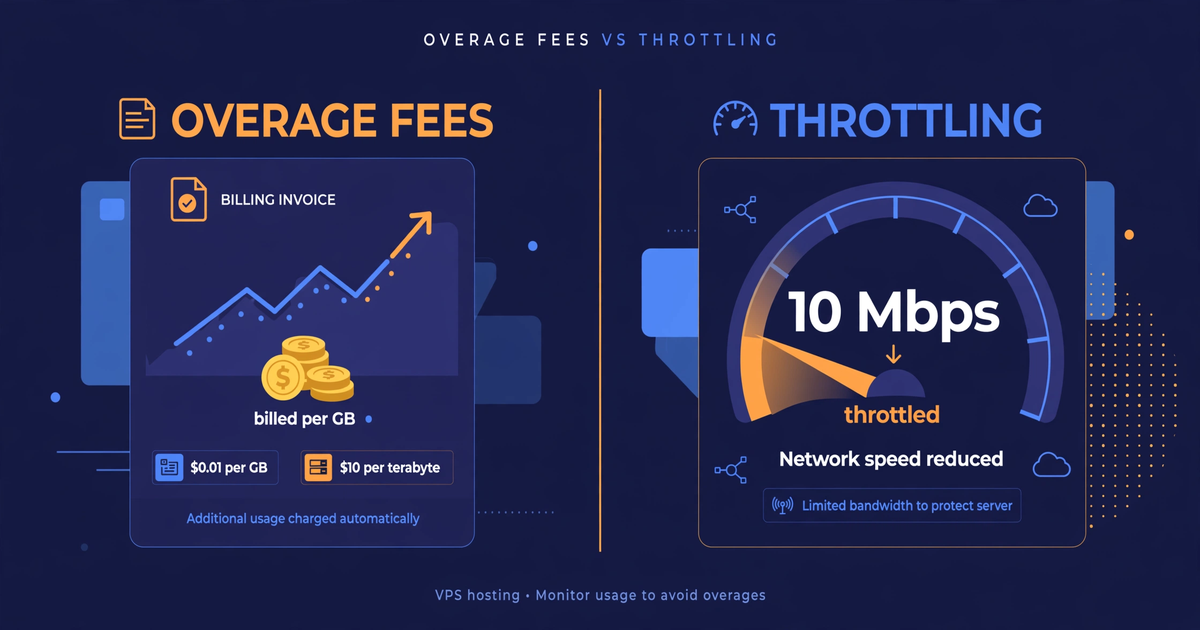
Short answer: you either get billed per gigabyte or get your port slowed to a crawl — and your pricing page won't warn you. We read five providers' actual terms pages on 2026-10-07, and the range is wide: Vultr and DigitalOcean charge about $10 per extra terabyte, Hetzner charges about €1 per extra terabyte, and OVHcloud doesn't bill you at all in most regions — it just throttles. Meanwhile, in our 2026-10-08 snapshot of 214 live offers across 31 providers, not one pricing card mentions an overage rate.
In this guide
| Provider | What happens past the limit | The rate |
|---|---|---|
| DigitalOcean (Droplets) | Billed; outbound only, inbound free, pooled per team | $0.01/GiB |
| Vultr (Cloud Compute) | Billed | $0.01/GB ≈ $10/TB |
| Hetzner (Cloud) | Billed in 100 MB blocks (EU); notified, not shut off | €1.00/TB |
| OVHcloud (VPS) | Unlimited in EU/US; APAC (Mumbai, Singapore, Sydney) capped, then throttled to 10 Mbps — no charge | $0 |
| AlphaVPS | Billed past the monthly quota — despite "NO METERS / FLAT PRICING" marketing | €3.00/TB |
Every rate above was read from the provider's own billing/terms page on 2026-10-07 (DigitalOcean docs: bandwidth billing; Vultr pricing FAQ; OVHcloud VPS page; Hetzner Cloud billing FAQ; AlphaVPS terms, section 02 Traffic Usage, updated 2025-01-28). The "not one pricing card mentions an overage rate" claim comes from our own 2026-10-08 snapshot: 214 live offers from 31 providers, scraped from official pricing pages — only 2 providers (IONOS, ScalaHosting) use the words "unlimited"/"unmetered" at all, and none print a per-unit overage figure.
Q1: What actually happens when you exceed the bandwidth limit?
One of three things, and which one depends entirely on the provider:
- You get billed per unit. The most common outcome. DigitalOcean charges $0.01 per GiB of outbound transfer past your quota (inbound is free, and quotas are shared across your team); Vultr charges $0.01 per GB; Hetzner charges €1.00 per extra terabyte in the EU, in 100 MB increments.
- You get throttled. Your speed drops but the bill doesn't move. OVHcloud does this in its Asia-Pacific regions: past the monthly quota, your port is limited to 10 Mbps until the cycle resets.
- Nothing happens. Some plans genuinely include unlimited traffic. OVHcloud's EU/US VPS plans and Contabo's cloud VPS line advertise unlimited traffic — though "unlimited" can still come with a slower port speed, which is the plan's real bottleneck.
Our take: this is the question you should ask support before you buy — "throttle or charge?" It takes one email and it tells you more about your worst-case bill than the plan's headline price does.
Q2: How much does overage cost in real money?
Take the most common rate, $0.01 per GB (DigitalOcean, Vultr): one extra terabyte costs about $10. To put that in context, our 2026-10-08 snapshot found DigitalOcean's own entry plan at $4 a month — so a single terabyte of overage costs 2.5x the price of the server itself. On Hetzner, that same terabyte costs about €1; on AlphaVPS, €3. The provider you picked for its cheap base price can be the expensive one the month your traffic spikes.
As one self-hosting user put it: a bandwidth cap is "the kind of cheap feature that only becomes expensive when you actually need it" — for something like n8n plus Postgres, the cap you ignored on day one is the bill you argue about in month three.
Q3: What's the difference between "unmetered" and "unlimited"?
They're not synonyms. Unmetered means the provider doesn't count your gigabytes — but it usually guarantees a speed instead, like 100 Mbps. Transfer as much as you want, but only that fast. A 200–600 Mbps port on an "unlimited traffic" plan is the same idea: no per-gigabyte bill, but physics does the throttling for them. Unlimited means no meter and no stated speed cap — though fair-use terms still apply, and a provider can act if your usage is genuinely abusive.
In our 214-offer snapshot, the word "unlimited" or "unmetered" appears in exactly 3 rows from 2 providers — it's marketing language, not an industry standard. If your job involves sustained throughput (video, backups, file sync), the port speed in the fine print matters more than the word "unlimited" in the headline.
Q4: Can a provider shut down my server over bandwidth?
Most mainstream providers don't shut you off for going over — DigitalOcean and Vultr bill you, Hetzner explicitly says it notifies you rather than suspending, and OVHcloud throttles in the capped regions. Suspension is usually reserved for abuse or unpaid bills, not overage. But watch for marketing that contradicts the terms: AlphaVPS's homepage says "NO METERS / FLAT PRICING", while its terms (updated 2025-01-28) charge €3.00 per terabyte past quota. When the ad and the contract disagree, the contract wins — that's drip pricing in a different costume.
Q5: How do I avoid a surprise bandwidth bill?
A five-step checklist, in order of how much money each step saves you:
- Before buying: ask whether the plan throttles or bills past the limit, and at what rate. Get it in writing from support.
- Read the region rules: unlimited in one region can mean capped-and-throttled in another (OVHcloud's APAC rule is the example).
- Do the worst-case math: if your app could push an extra terabyte in a spike month, add $10 (Vultr/DO-class pricing) to the plan's price and compare that number against a plan with unlimited traffic.
- Watch the port speed: on "unlimited traffic" plans, the Mbps figure is the real limit — 200 Mbps caps you at roughly 65 TB/month even if nobody meters you.
- Monitor: most providers have a bandwidth graph in the control panel; check it monthly, not at the invoice.
Our take: the most dangerous plan isn't the expensive one — it's the cheap one where your best month of traffic is also your most expensive month. If bandwidth is the job, buy the plan whose overage rule fits in one sentence.
Data & sources
- Price snapshot: 214 live offers from 31 providers, scraped from official pricing pages, fetched 2026-10-08T22:37Z.
- Overage rules: five providers' billing/terms pages, read 2026-10-07 — full URLs in our drip pricing Q&A research notes. All rates are the providers' own published figures.
- Community questions: r/Hosting "Cheapest VPS I found has a bandwidth cap nobody warns you about" (2026-08-28); lowendbox commenters asking why deal posts carry no bandwidth terms — the complaint that started this article.
Related reading: hourly vs monthly pricing · running a VPN on the cheapest VPS