Published 2026-10-21
Is That $1/Month VPS Deal Legit or a Scam? A 5-Check Vetting Guide
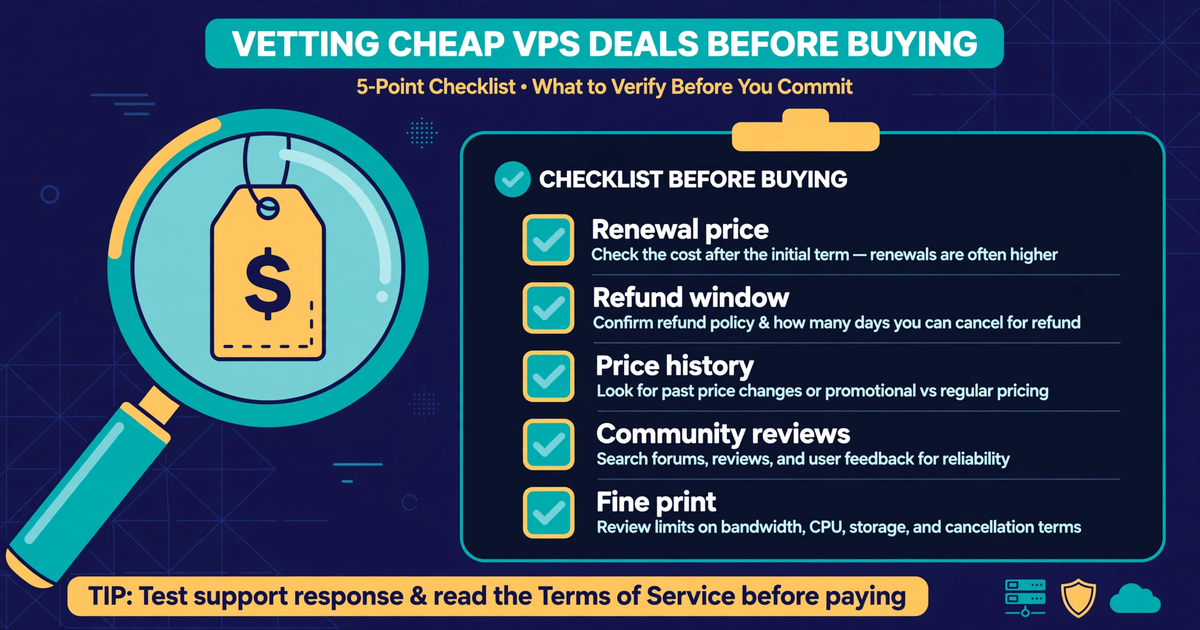
Short answer: run five checks before you pay, and the cheapest deals almost always pass — the scam is rarely the headline price. Here is the 60-second version of the vetting table this guide is built on:
In this guide
- Check 1: Is the renewal price printed?
- Check 2: How long is the refund window?
- Check 3: Has the headline price been stable?
- Check 4: What does the community actually say?
- Check 5: What does the cheapest tier really cost?
- The 30-second verdict: most cheap deals are legit, the exit is the product
- Data notes
| Check | Legit (buy) | Scam-shaped (walk away) |
|---|---|---|
| 1. Renewal price | Printed next to the headline price | Missing — and in our 2026-10-08 audit, 23 of 26 provider pricing pages showed no renewal number at all |
| 2. Refund window | 30 days or more, written in the terms | No refunds, or a 3-day window limited to your first service, once per account, ever |
| 3. Price history | Stable headline price over weeks | Headline jumps, or renewal multiplies without warning |
| 4. Community footprint | Real user reports on Reddit, LowEndTalk, or Web Hosting Talk | Only marketing pages and coupon sites mention it |
| 5. Cheapest-tier fine print | $1/mo means $1/mo, billed monthly | The "$1" row is $0.01/hour, an annual prepay, or a teaser with a locked-in renewal |
The data behind this guide: a snapshot of 223 live VPS price cards across 32 providers, taken 2026-10-20, 28 days of tracked price history (190 price series, 116 snapshots), our renewal-price audit from 2026-10-08, and our refund-policy audit from 2026-10-17. Every number below comes from those — nothing is guessed.
Check 1: Is the renewal price printed?
This is the single most predictive check we know. A legit provider shows you what the plan costs after the promotion. A scam-shaped one shows you only the teaser.
In our audit of 26 provider pricing pages on 2026-10-08, 23 showed no renewal price anywhere on the page. That is not an accident — it is the industry's default. When the renewal number is shown, the ratio tells you everything: Hostinger's KVM 1 line is advertised at $6.49/month on a 24-month term and renews at $11.99, a 1.85x jump. DreamHost's plans renew at roughly 2.5x their intro prices. A real user on r/selfhosted watched a bill go up 543% in two years because the renewal math was never on the pricing page.
The rule: if you cannot find the renewal price in one minute of looking, treat the headline price as fiction and budget for 2–3x. A provider that hides the renewal is not necessarily a scam — most of the market does it — but it is a provider that profits from you not asking.
Check 2: How long is the refund window?
The refund window is the provider's bet on its own service. We verified ten providers' official refund pages on 2026-10-17, and the spread is enormous:
| Provider | Refund window | The catch |
|---|---|---|
| InMotion | 90 days | Multi-month VPS plans |
| Ethernet Servers | 60 days | Full refund on request |
| Hostinger | 30 days | No repeat VPS refund within 180 days — you get one exit, not two |
| NYCServers | 14 days | Eligible VPS services; crypto payment network fees are deducted |
| MVPS.net | 3 days | First service only, once per account, for life |
| RackNerd | None | Official policy: no refunds, no money-back guarantee |
Notice the pattern the budget end of the market runs on: the cheaper the headline price, the shorter the exit. One community discussion on LowEndTalk put it bluntly — if it is a cheap VPS, "you are not likely to find a free trial or a money-back guarantee." That is not proof of a scam; it is the standard trade at the bottom of the market. The dangerous combination is annual prepay plus no refund window: you are locked in for 12 months with no exit if the service is bad. Community math says a refund window costs you roughly 3–4x more for the same specs elsewhere — that is the honest price of an exit, and it is worth knowing before you commit.
The rule: first month always monthly. Buy the exit before you buy the deal, and only prepay a year after the provider has proven it does not need your refund.
Check 3: Has the headline price been stable?
Here is where our own tracking helps. We keep 28 days of price history across 190 tracked price series (116 snapshots, 2026-09-23 to 2026-10-20). In that window, seven series crossed the 50% move line — and every one is scrape noise, not a price change. Six are two-snapshot blips from plan-card remapping; the seventh, a DreamHost card, flip-flops between $39.99 and $59.99 as two plan cards swap positions in the scrape. Zero genuine headline-price moves in 28 days. Providers do not normally rug-pull the listed price — the industry norm is a stable headline with the real jump hiding in the renewal column.
What moves is what the price card does not show. The 543% bill increase from r/selfhosted did not come from a headline change; it came from a renewal the pricing page never printed. Independent nightly tracking has caught a 40% increase that a first scrape missed, and a plan whose promotional price ran out after three months while the card still looked the same. So the check is not "did the card price change" — it is "what does the card not price."
The rule: a stable headline price is a good sign but proves nothing about your second invoice. Stability you can verify is worth more than a promotion you cannot.
Check 4: What does the community actually say?
Search "Is [provider] legit or a scam?" — it is one of the most-asked budget VPS questions on Reddit, and the answers are more useful than any review site. Look for three things:
- Volume over time. A provider with two years of LowEndTalk or r/VPS threads is auditable. A provider that exists only on coupon sites is not.
- The specific complaint. "Support is slow" is normal for budget hosts. "They deleted my data on cancellation" or "charged my card after I cancelled" is not.
- The honest middle. The best summary of the budget tier we have seen came from a Hacker News thread: the lowendbox-style hosts "will very likely work, but they don't have the history for me to trust business critical tasks." That is the correct mental model — legit does not mean enterprise-grade.
The rule: no community footprint, no purchase. Marketing copy is a claim; three years of forum threads are evidence.
Check 5: What does the cheapest tier really cost?
The $1 headline is where most "is this a scam?" anxiety lives. Our 2026-10-20 snapshot puts it in context: the median entry plan across 24 providers is $4.77/month; 15 providers start at $5 or less, 7 at $3 or less, and only 3 under $2 — Hostens at $1.00, Latitude.sh at $1.23, BuyVM at $1.25. A genuine $1/month tier is rare, which is why the "$1" rows deserve a second look:
- Hourly, not monthly. 18 sub-$1 rows in our snapshot, spread across 6 providers, are metered rates ($0.01/hour and similar) — not $1/month plans. They are fine for tests, misleading as headlines.
- Annual, not monthly. A "$1.83/month" plan may be $21.99 paid up front for the year — and per Check 2, that prepay often comes with a weak refund window.
- Missing specs. In our audit, 219 price cards produced only 14 that even print the word "KVM". A card that hides the virtualization type, the bandwidth cap, and the renewal price is not lying — it is just not telling you anything you can plan on.
The rule: read the cheapest row as a riddle, not a price. If the billing unit, the term, and the renewal are all clear, a $1 plan is a deal. If any one of them is vague, it is a teaser wearing a price tag.
The 30-second verdict: most cheap deals are legit, the exit is the product
Stack the five checks and a pattern emerges: the budget VPS market is not full of scams — it is full of missing information. Zero of our 223 tracked cards mention refunds. Twenty-three of 26 pricing pages hide the renewal. Eighteen sub-dollar rows look monthly but bill hourly. None of that is fraud; all of it is the provider betting you will not check.
Our take: buy the exit, not the deal. First month always monthly, from a provider whose renewal price is printed and whose refund window you have read. The cheapest honest plan in our snapshot is Hostens at $1.00/month — but the cheapest safe first purchase is the one you can leave. Scams are rare in this market; bad exits are everywhere. Check for the exit first and the price second, and the $1 deals stop looking scary.
Data notes
- Price snapshot: 223 live price cards, 32 providers, taken 2026-10-20 (offers.json generated_at 2026-10-20T20:58Z). Median entry price $4.77/month across the 24 providers with a USD monthly tier.
- Price history: 190 tracked series, 116 snapshots from 2026-09-23 to 2026-10-20; seven series crossed the 50% line but all are scrape noise (six two-snapshot blips, one DreamHost card flip-flopping $39.99/$59.99 as plan cards swap scrape order) — zero genuine headline-price moves in 28 days (history.json).
- Renewal audit: 26 provider pricing pages checked 2026-10-08; 23 showed no renewal price.
- Refund audit: 10 providers' official refund pages verified 2026-10-17; see the table above.
- Community quotes are paraphrased from public Reddit, Hacker News, and LowEndTalk threads collected in our research notes; we quote the question wording, not full posts.