Published 2026-10-22
Is an ARM VPS Slower Than x86? A Q&A With Real Prices
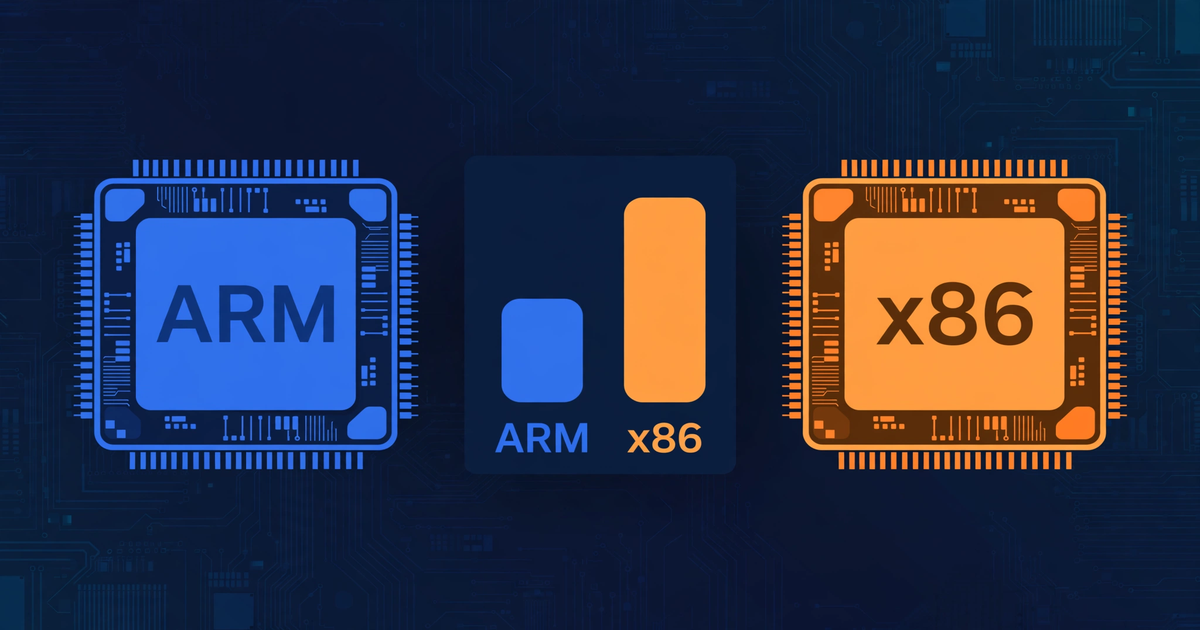
Short answer: barely — and for the money, often faster. Independent 2026 tests put one Ampere Altra ARM core within 7–10% of an x86 core in throughput, and ARM plans pack more cores per dollar, so total performance frequently comes out ahead. The real questions are not about speed at all — they are about what runs on ARM, what does not, and whether the discount is real. Here is the 60-second version:
In this guide
- Q1: Is an ARM VPS slower than x86?
- Q2: How much cheaper is ARM, really?
- Q3: Can I run WordPress on an ARM VPS?
- Q4: Is ARM good for game servers?
- Q5: Can I run Windows on an ARM VPS?
- Q6: Can I switch from x86 to ARM later?
- Q7: What does our own price data say about ARM?
- Our take: buy x86 by default, buy ARM on purpose
- Data notes
| Question | 60-second answer |
|---|---|
| Is ARM slower? | Single core: 7–10% behind. Total box: often faster, because you get more cores for the money. |
| How much cheaper? | Reported September 2026 numbers: ~13% below the x86 twin at Hetzner, ~25% at netcup. |
| WordPress on ARM? | Yes — Nginx, PHP, and MySQL all ship ARM builds; the gap vanishes behind a cache. |
| Game servers on ARM? | No — single-threaded game loops want peak single-core speed: x86. |
| Windows on ARM? | Effectively not an option at the budget tier: x86 required. |
| Switch x86 → ARM later? | Not in place — budget for a rebuild, not a reboot. |
The data behind this Q&A: a snapshot of 216 live VPS price cards across 32 providers, taken 2026-10-21, in which we audited every card title for architecture mentions, plus independently reported 2026 ARM-vs-x86 numbers from provider pages and benchmarks. Every number below comes from one of those two sources — nothing is guessed.
Q1: Is an ARM VPS slower than x86?
Barely, and the honest version has two halves. The first half: yes, per-core, ARM trails. An independent 2026 test found roughly a 7–10% throughput gap against x86, larger on single-thread benchmarks. The second half: that gap rarely decides anything, because ARM plans are built to give you more cores for the same money — a single ARM core on Ampere Altra is comparable to an x86 core for most tasks, and total performance is often higher at the same price point. One hosting guide's rule of thumb: most WordPress setups behind a cache layer will not feel the difference at all.
The rule: do not buy or reject ARM on "slower." Buy or reject it on the workload table in Q3–Q5. Speed is the least interesting difference.
Q2: How much cheaper is ARM, really?
Reported September 2026 numbers from two European budget providers, same-spec comparisons:
| Provider | ARM plan | x86 twin | ARM discount |
|---|---|---|---|
| Hetzner | CAX11 (2 vCPU Ampere Altra, 4 GB RAM): €3.29 | CX22 (x86): €3.79 | ~13% |
| netcup | VPS 1000 ARM (6 vCPU, 8 GB RAM, 256 GB NVMe): €7.77 | VPS 1000 x86: €10.37 | ~25% |
Two caveats, both from the same reporting. First, these are provider list prices from September 2026 — verify the current page before buying. Second, supply is the catch: as of late September 2026, netcup's ARM line was sold out and Hetzner had pulled its CAX plans from the price list. The discount is real; the inventory is not always there. An ARM plan you cannot buy is not cheaper than anything.
The rule: treat the 13–25% as the discount band to expect. If an ARM plan costs the same as its x86 twin, the architecture is not buying you anything — buy on the rest of the spec sheet instead.
Q3: Can I run WordPress on an ARM VPS?
Yes. The standard web stack — Nginx, PHP, MySQL — all ship native ARM builds, so a normal WordPress install runs on ARM exactly the way it runs on x86. The one condition: your plugins and any compiled extensions must be ARM-compatible too. In practice, the PHP/WordPress world is overwhelmingly fine; the exotic breakage lives in niche binary plugins. This is also the workload where the 7–10% gap matters least — a page served from cache never touches the CPU difference.
The rule: WordPress is ARM's safest budget workload. If your whole stack is PHP + MySQL + Nginx, ARM is a discount with no asterisk.
Q4: Is ARM good for game servers?
No — this is ARM's clearest "stay away" at the budget tier. Game servers run their main loop on a single thread, so peak single-core speed beats core count, and that is exactly where ARM trails x86 most. One 2026 benchmark of ultra-cheap VPS plans makes the point brutally: an 8-vCPU plan delivered 76% less single-core throughput than a 2-vCPU plan from a different provider — for gaming, the architecture of the fastest single core is the whole decision. Community guidance agrees: gaming servers want high single-thread CPU performance and low latency, which is better handled by x86-based VPS.
The rule: game server → x86, no debate. ARM's extra cores are cores your game loop will never use.
Q5: Can I run Windows on an ARM VPS?
Effectively no. Windows Server support on ARM VPS is limited — providers that sell ARM sell it as a Linux product. If your workload needs Windows (RDP apps, .NET Framework legacy, MT4/MT5 trading terminals), you need x86, full stop. The Windows question is settled one layer below the ARM question: our 2026-10-18 audit found exactly one Windows mention in 214 price cards, and the cheapest Windows plan started at $6.33 — the budget Windows market is thin enough without adding architecture constraints.
The rule: Windows → x86. ARM is a Linux-only aisle.
Q6: Can I switch from x86 to ARM later?
Not in place. Moving an existing server from x86 to ARM means rebuilding: applications may need reconfiguration or recompiling, container images need ARM variants, and anything with a hardcoded x86 binary breaks. Treat the architecture choice as load-bearing at purchase time — the same way you would treat the operating system. The cheap move is deciding before you deploy, not migrating after.
The rule: pick the architecture on day one. There is no "try x86, flip to ARM later" button.
Q7: What does our own price data say about ARM?
Here is the finding that surprised us: zero of our 216 tracked price cards mention ARM. We searched every card title in the 2026-10-21 snapshot — 14 print "KVM", 27 mention storage, 8 mention backups, 3 mention IPv6, and precisely none mention ARM, Ampere, LXC, OpenVZ, or Xen. At the headline tier of the budget market, ARM is invisible. The architecture conversation happens one layer deeper, on plan pages and docs — never in the price card.
The same snapshot's x86 floor, for context: the median entry plan across 23 providers with a USD monthly tier is $4.99/month; 14 providers start at $5 or less, 7 at $3 or less, and 3 under $2 — Hostens at $1.00, Latitude.sh at $1.23, BuyVM at $1.25. ARM's reported 13–25% discount applies against mid-tier x86 plans, not against these $1–$3 floor plans — which is why the cheapest ARM plan you can actually buy is rarely the cheapest plan on the page. Independent 2026 benchmarking advice agrees with the frame: benchmark the actual plan, not the instruction set — the best value at some clouds is ARM and at others is still AMD.
The rule: if a provider's ARM plan is not visibly cheaper than its own x86 twin, the architecture label is marketing. Compare plans, not acronyms.
Our take: buy x86 by default, buy ARM on purpose
We would buy x86 by default at the budget tier — not because ARM is worse, but because the ARM discount is real only where it is priced real, and the plans that carry it sit one tier above the $1–$3 floor and can go out of stock. Our decision rule is simple: choose ARM when your workload runs natively on it (WordPress, containers, batch jobs) and the plan is at least 13% below its x86 twin; choose x86 for game servers, anything Windows, and any stack with a binary you did not compile yourself. Architecture is a discount mechanism, not a quality tier — treat it like a coupon: verify the number, check the exclusions, and never let it decide the purchase by itself.
Data notes
- Price snapshot: 216 live price cards, 32 providers, taken 2026-10-21 (offers.json generated_at 2026-10-21T20:59:48Z). Median entry price $4.99/month across the 23 providers with a USD monthly tier (14 at $5 or less, 7 at $3 or less, 3 under $2). Architecture audit: 0 cards mention ARM/Ampere, 14 mention KVM, 0 mention LXC/OpenVZ/Xen/Hyper-V, 27 mention storage, 3 mention IPv6, 1 mentions Windows.
- ARM-vs-x86 numbers: Hetzner CAX11 €3.29 (2 vCPU Ampere Altra, 4 GB RAM) vs CX22 €3.79, and netcup VPS 1000 ARM €7.77 (6 vCPU, 8 GB RAM, 256 GB NVMe) vs x86 €10.37, as reported in a September 2026 independent ARM hosting guide; same source notes netcup ARM sold out as of 2026-09-21 and Hetzner CAX removed from the price list. Single-core gap of 7–10% from an independent 2026 benchmark; "benchmark the plan, not the ISA" from a 2026 VPS benchmarking roundup.
- Workload guidance (WordPress compatibility, gaming single-thread preference, x86→ARM rebuild requirement, Windows-on-ARM limits) paraphrased from public provider docs and community FAQs collected in our research notes; we quote the question wording, not full posts.