Published 2026-10-11
Intro Price vs Flat Rate: The 24-Month Math Behind Cheap VPS Deals
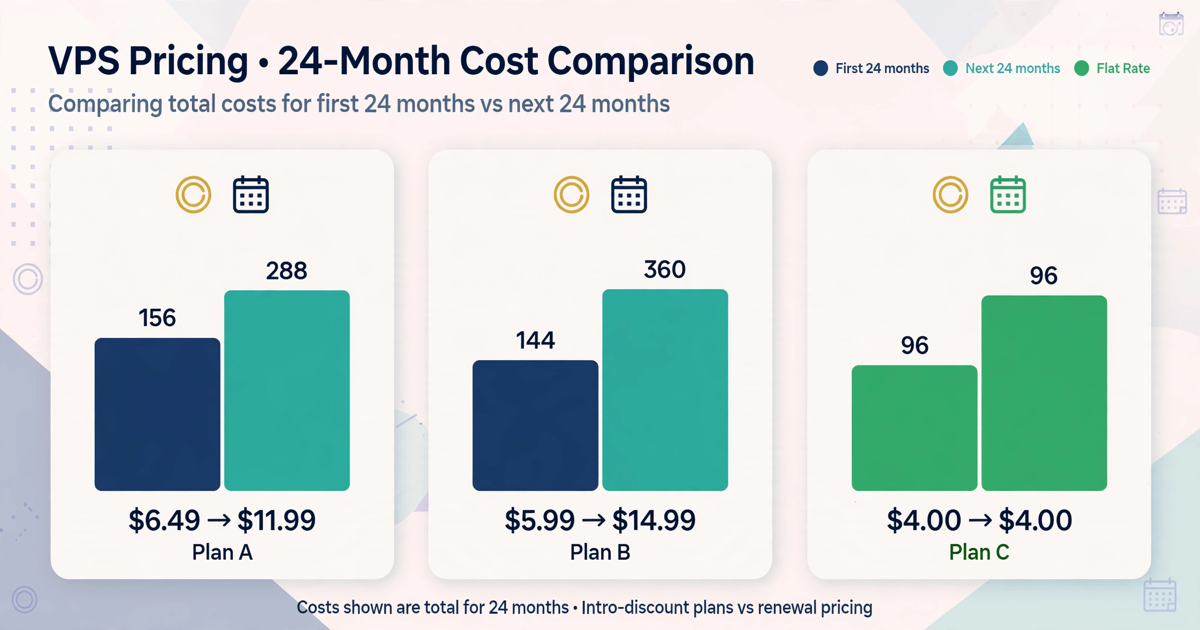
Short answer: the headline monthly price is only half the deal — the other half is the renewal price, and on intro-discount plans the second two years routinely cost 1.8x to 2.6x the first. Here is the 24-month math on real plans from our 2026-10-08 price snapshot (214 live offers across 31 providers, scraped from official pricing pages):
In this guide
| Plan | Intro price | Intro term | Renewal price | First 24 months | Next 24 months |
|---|---|---|---|---|---|
| Hostinger KVM 1 | $6.49/mo | 24 months | $11.99/mo | $155.76 | $287.76 |
| DreamHost Stack 4 | $5.99/mo | First 2 years | $14.99/mo | $143.76 | $359.76 |
| IONOS VPS (M+ class) | $5/mo × 3 mo | Intro period | ≈$14/mo after | $141.00 (year one = $11.75/mo effective) | — |
| DigitalOcean entry Droplet | $4/mo, flat — no intro discount | $4/mo | $96.00 | $96.00 | |
Hostinger and DreamHost figures are paired intro/renewal rows from our own 2026-10-08 snapshot (Hostinger: "Choose VPS KVM" $6.49 next to "Renews at" $11.99; DreamHost: "First 2 years at" $5.99 next to "Auto-renews at" $14.99). The IONOS row quotes a 2026 dev.to pricing analysis: $5 for three months and $14 for nine months, $141 in year one. The DigitalOcean row is our snapshot's $4 "Droplets Starting at" line — a flat-rate plan with per-second billing underneath.
The two pricing camps
Almost every cheap VPS plan falls into one of two camps. Camp one: intro-discount plans. A big headline number for the first term — 12 or 24 months — and a smaller "renews at" number somewhere below it. Hostinger, DreamHost, IONOS, and InMotion (whose 2026-10-08 rows show "Renews at" $16.99–$56.99) all play here. Camp two: flat-rate plans. One number, same every month, no discount clock ticking. DigitalOcean's $4 entry Droplet is the classic example: it bills per second with a 60-second minimum, but the monthly starting price never changes.
Telling the camps apart should be easy, but often isn't. In our 2026-10-08 audit of pricing pages, 23 of 26 providers printed no renewal figure at all — no number to pair with the intro price, just "renews at standard rates" language or nothing. A plan with no visible renewal price is camp one by default; treat it as one.
The 24-month math (do this before you buy)
The formula is simple, and it is the whole method:
Total over your horizon = (intro price × intro months) + (renewal price × remaining months).
Work it through on Hostinger KVM 1. Intro: $6.49 × 24 = $155.76 for the first two years. Then the renewal clock starts: $11.99 × 24 = $287.76 for the next two years. Over four years you pay $443.52 — an effective $9.24/month for a plan advertised at $6.49. The renewal price, not the intro price, is what the plan actually costs you long-term.
DreamHost Stack 4 is steeper: $5.99 × 24 = $143.76 for the first two years, then $14.99 × 24 = $359.76 for the two after — a 2.5x jump, $216 more for the same server. And IONOS shows how the first year itself can mislead: "$5 three times and $14 nine times" is $141 in year one, which is $11.75 a month effective — more than double the $5 headline.
Intro prices move, too. Hostinger's KVM 1 intro rose from $4.99 to $6.49 on 2026-03-03, and its renewal rate rose from $9.99 to $11.99 a few days earlier (2026-02-27), per a 2026 dev.to nightly price-tracking project. Both numbers in the pairing can change — the math only holds if you recheck both.
When the flat plan wins — and when the intro still wins
As one dev.to commenter put it, "flat-rate plans look expensive in month one and cheap in month 30." Run the horizon math and you see why: DigitalOcean's $4 entry costs $96 for 24 months and $192 for 48. Hostinger KVM 1 costs $155.76 then $287.76 — $443.52 over the same 48 months. (Specs differ between the two, so treat this as the method demonstrated, not a buy recommendation: run the same arithmetic on the tier you would actually buy.)
But intro pricing is not a scam — it is a tool with a use case. It wins when your horizon is shorter than the intro term: a 6-month project, a migration you plan to revisit, or a server you fully expect to move when the discount ends. The trap is only buying the intro price for a server you will keep for years. As another dev.to writer warned: "a $1.99 intro that renews at $25.99 is a much more expensive site."
How to find the renewal price (three checks)
- Read the small print under the price — the "renews at" line is usually there, in gray, two font sizes down. Hostinger and DreamHost both print it on their pricing pages (that is where our pairings came from).
- Search the page for "renew" — InMotion's rows literally say "Renews at" with the dollar figure. If your browser finds nothing, see check three.
- Assume camp one and budget the worst case. With 23 of 26 providers printing no renewal number at all (our 2026-10-08 audit), the honest move is to treat a missing renewal price as "at least 2x the intro" — the measured range on real pairings is 1.85x to 2.58x — or pick a flat-rate plan where the number is the number.
Our take
I now price every VPS plan at its renewal rate and treat the intro discount as a rebate, not a price. A $6.49 plan that renews at $11.99 is an $11.99 plan with a two-year coupon — and once you read it that way, the flat $4 or $8 plan stops looking expensive. The cheapest plan over the time you will actually run the server is the cheapest plan. Do the 24-month math; it takes ninety seconds and it has never once told me the headline was the truth.
All snapshot figures are from our 2026-10-08 scrape of official provider pricing pages (214 offers, 31 providers, 190 USD-denominated rows). Intro/renewal pairings for Hostinger and DreamHost were verified as adjacent rows in that snapshot; the IONOS year-one figure and the 2026-03 Hostinger price moves are from public 2026 dev.to pricing analyses quoted above. Prices change — treat these as dated evidence, not a quote.