Published 2026-10-19
How Much RAM Does a Minecraft Server Need on a Cheap VPS? A Per-Player Sizing Guide
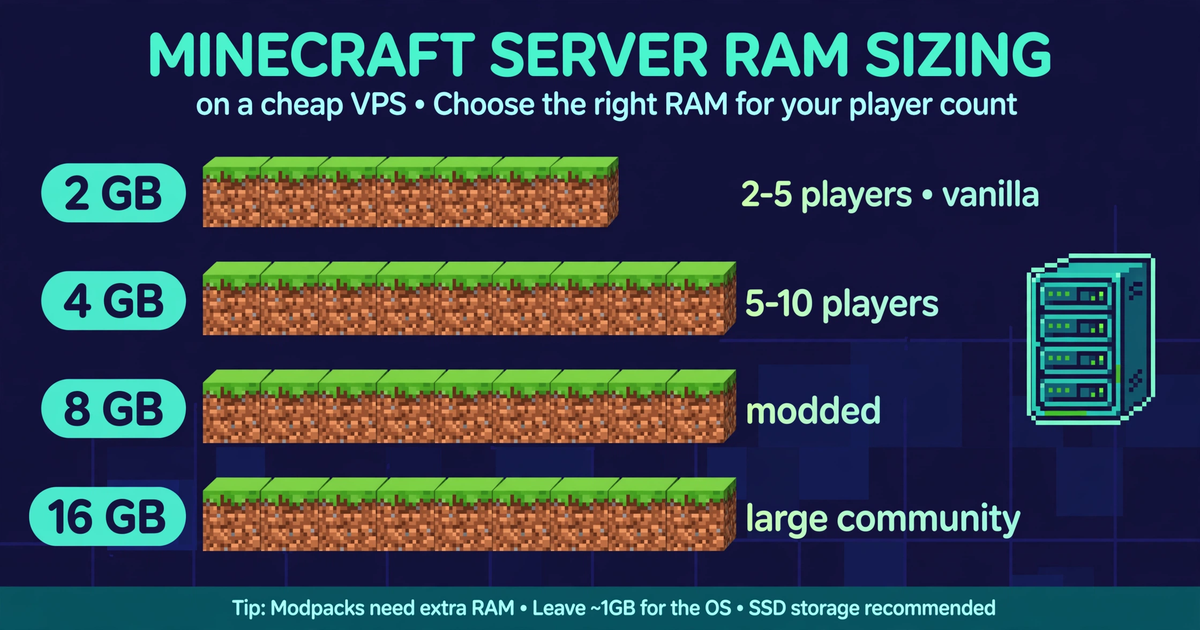
Short answer: 2 GB of RAM is the starting point for most Minecraft servers; budget roughly 300 MB of RAM per vanilla player and 500 MB per modded player. We audited 214 live VPS price cards (snapshot taken 2026-10-18, 26 providers). The median entry plan costs $4.54/mo, and 15 of 23 providers with a USD entry tier sell it at $5 or less — so a small vanilla server for friends fits squarely inside the cheapest tier of the market. A modded server for 10+ players does not: that needs 4–8 GB, which prices you out of the entry tier entirely. The table below is the whole answer.
In this guide
- The per-player math
- What our 214 price cards actually tell you — and what they don't
- Trap 1: more cores does not mean a faster Minecraft server
- Trap 2: CPU steal time — the lag your ping can't explain
- Trap 3: DDoS, location, and the Realms alternative
- Two free performance wins before you pay for more RAM
- Our take
| Server | Players | RAM you need | What our 214-card snapshot says about cost |
|---|---|---|---|
| Vanilla survival | 2–5 | 1–2 GB | Fits the entry tier: median entry $4.54/mo; 15 providers at $5 or less |
| Vanilla / Paper + a few plugins | 5–10 | 2–4 GB | Top of the entry tier; compare plans by their RAM spec, not the headline price |
| Light modpack | 2–5 | 4 GB | Above most entry tiers; the market's $1-per-GB anchor puts this near $4/mo |
| Large modpack (100+ mods) | any | 6 GB+ | Mid-tier plans only; entry tiers can't hold this |
| Mojang Realms (for comparison) | you + 2 / you + 10 | handled for you | $3.99/mo (Bedrock, 3 players) or $7.99/mo (up to 10 players) — no mods on Java |
The per-player math
Server guides converge on the same arithmetic. A vanilla server runs on about 1.5 GB of RAM for 1–5 players, which works out to roughly 300 MB of RAM per player — and a 2 GB server is widely cited as the sensible starting point for most people, since you can upgrade later. Well-tuned setups (Paper with sensible limits) get that down to 50–100 MB per player on a decent CPU. Modded is a different animal: budget around 500 MB per player, or about 200 MB per player if you aggressively limit chunk loading. The pattern is linear enough to plan with: players × 300 MB (vanilla) or players × 500 MB (modded), then round up to the next plan size.
What our 214 price cards actually tell you — and what they don't
Here is the exclusive part of this guide: our snapshot from 2026-10-18 tracked 214 live offers across 26 providers. The median cheapest entry plan costs $4.54/mo. Fifteen providers price their entry tier at $5 or less; seven go as low as $3 or less (Hostens $1.00, Latitude.sh $1.23, BuyVM $1.25, IONOS $2.00, Virmach $2.00). Nineteen sub-dollar rows are hourly or add-on lines, not monthly plans — strip those out before comparing.
And here is the trap the cards set: not one of the 214 price cards prints a RAM spec next to its headline price. You cannot size a Minecraft server from a price card alone, because the card never tells you the one number that matters. The correct method is backwards from how most people shop: compute your RAM from the per-player table first, then open the provider's plan page and buy the RAM number — the headline price is the last thing you look at, not the first. For calibration, the broader market's going rate is about $1 per GB of RAM per month on budget Minecraft hosting, which puts a 4 GB modded-capable box near $4/mo — right in line with our snapshot's $4.54 median entry.
Trap 1: more cores does not mean a faster Minecraft server
Minecraft's main game loop runs on a single thread, so single-thread CPU speed beats core count almost every time. This is where cheap-VPS marketing lies most aggressively. Independent benchmarks of ultra-cheap VPS plans found one provider's 8-vCPU plan scoring 387 events per second on single-core tests — 76% slower than a competing 2-vCPU plan that scored 1,636. Four times the cores, three-quarters slower, because the underlying silicon was ancient or oversubscribed. On a cheap VPS, "8 vCPU" on the tin tells you nothing; the CPU model and clock speed tell you everything. If a provider won't name the CPU, treat the core count as decoration.
Trap 2: CPU steal time — the lag your ping can't explain
On a shared VPS, your "vCPU" is a time slice of a physical core shared with neighbors. When a
neighbor hogs the core, the hypervisor steals cycles from you — this is CPU steal time, and
budget hosts never advertise it. For a website it barely matters: a page loads 200–500 ms later
and nobody notices. For a game server it is catastrophic, because the game loop must complete
every 15–50 milliseconds; a stolen slice means teleports, frozen mobs, and blocks that reappear.
The practical rule from VPS monitoring guides: 1–3% steal is invisible, 25%+ means the box is
running in slow motion and you should switch hosts. After deploying, run top and watch
the st value during your busiest hour — that number is your real CPU spec.
Trap 3: DDoS, location, and the Realms alternative
Two more cheap-VPS realities. First, budget hosts are the classic null-route victims: one small DDoS attack and an oversold host may simply drop your IP to protect everyone else — community admins report exactly this pattern on the cheapest tiers. If your server will be public, confirm DDoS protection exists before you buy. Second, location beats size: a 2 GB box in the same region as your players will feel better than a 4 GB box on another continent, because latency complaints arrive long before RAM complaints.
And know when not to self-host: Mojang's own Realms costs $3.99/mo for you plus two friends on Bedrock, or $7.99/mo for up to ten players — with backups and zero setup. The catch is no plugins and no modpacks on Java. If your group is small, vanilla, and allergic to Linux, Realms at $3.99 is cheaper than any VPS once you price your own time.
Two free performance wins before you pay for more RAM
First, run Paper (or Purpur) instead of pure vanilla: it is measurably more efficient at the same player count, with async chunk loading and real performance controls. Second, turn the view distance down 1–2 chunks on public servers — it saves CPU and RAM without hurting gameplay in any way most players notice. Both are free, and both move the bottleneck before your wallet has to.
Our take
I would size every Minecraft server the same way: players × 300 MB, round up, buy that RAM
number, ignore the headline price until the last step. In our 2026-10-18 snapshot the median
entry tier is $4.54/mo, which is exactly the neighborhood a 2 GB vanilla box lives in — the
$1.00–$2.00 teasers are for buying, not for gaming. Start monthly, run top during
peak hour, and only commit to a longer term once steal time stays under 3% for a full week of
real play.
Related reading: VPS sizing guide · what a VPS costs per month