Published 2026-10-08
$6.49 First, $11.99 on Renewal: A Q&A on Drip Pricing in Cheap VPS Ads
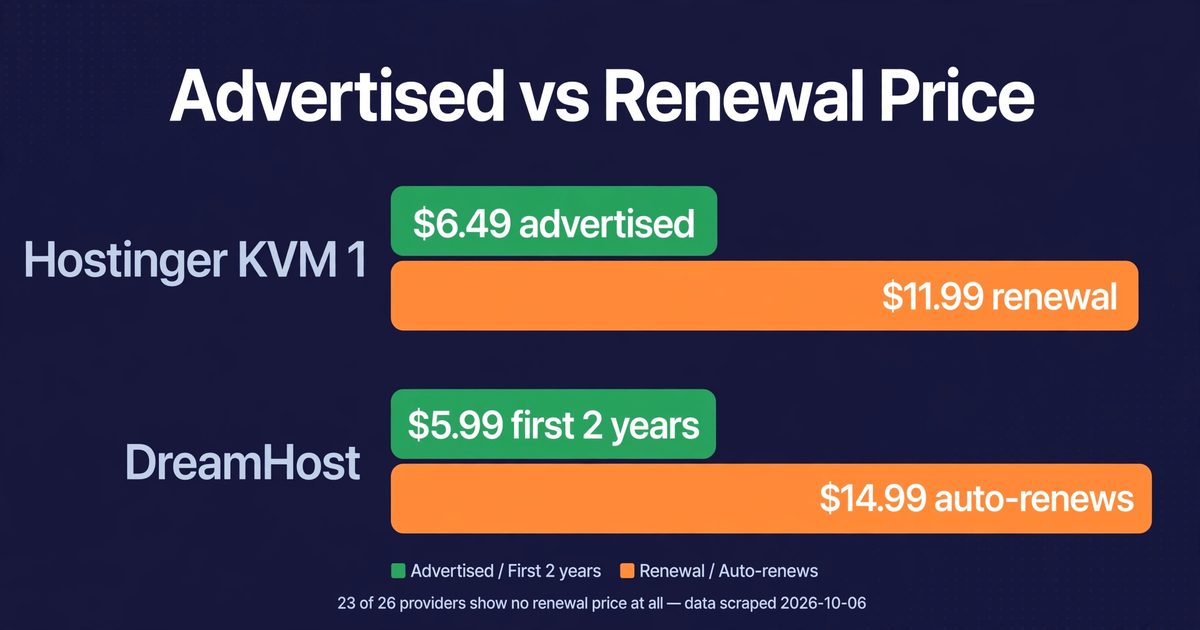
Short answer: the big number in the ad is the intro price, not your price. In our 2026-10-06 snapshot of 215 live VPS offers across 26 providers, the renewal number is printed right on the same page for only three providers — and where it appears, it runs 1.85x to 2.58x the advertised price. Everyone else shows you one number and lets you discover the second one on your invoice.
In this guide
- Q1: What is "drip pricing"?
- Q2: How do I know the pair above is real and not a scraping mix-up?
- Q3: How common is this? Do most providers hide the renewal price?
- Q4: What's the real first-year cost, then? How do I compute it?
- Q5: Are there providers that don't play this game?
- Q6: So is the $6.49 deal still worth taking?
| Provider | Advertised (first-term) price | Renewal price, same page | The jump |
|---|---|---|---|
| Hostinger KVM 1 | $6.49 | $11.99 | 1.85x (+85%) |
| DreamHost | $5.99 (first 2 years) | $14.99 (auto-renews) | 2.50x (+150%) |
| DreamHost | $9.49 (first 2 years) | $23.49 (auto-renews) | 2.47x (+148%) |
| DreamHost | $15.49 (first 2 years) | $39.99 (auto-renews) | 2.58x (+158%) |
| InMotion Hosting | not shown in our scrape | $16.99–$56.99 ("renews at", 24-month term) | intro hidden |
Every figure above was scraped from the provider's own pricing page on 2026-10-06. Intro and renewal figures come from separate cards on the same page; Hostinger pairs are listed as intro/"renews at" card pairs, and DreamHost pairs are matched in the order the cards appear (note the near-identical ~2.5x ratio across all three pairs, which is what makes the matching credible). The renewal cards name no plan — that ambiguity is part of the problem. InMotion's page lists only the renewal rate, no intro price at all. 215 live offers, 26 providers, 190 in USD.
Q1: What is "drip pricing"?
It's the name shoppers gave to the practice of advertising a price that excludes fees and conditions you can't avoid — the total "drips" out later. On a recent r/SelfHosting thread asking why VPS hosts "lie about pricing", one commenter noted that some countries already outlaw it: in Australia, consumer law requires the headline price to include all unavoidable fees. The US has no such rule for hosting, so the advertised VPS price is usually the best-case price: longest term, first billing cycle, promo applied.
Q2: How do I know the pair above is real and not a scraping mix-up?
Fair question — card scrapers can misalign rows. Two checks: first, the Hostinger pairing is confirmed by an independent September 2026 price check that lists the KVM 1 at exactly $6.49 advertised and $11.99 on renewal, the same numbers our scraper read on 2026-10-06. Second, the DreamHost pairs land at 2.50x, 2.47x and 2.58x — three independent card pairs converging on the same multiplier is a pattern, not a coincidence. What the scrape can't tell you is which renewal card belongs to which plan name, because the renewal cards don't name the plan. Treat the individual DreamHost rows as ±one card of uncertainty; the direction and scale of the jump are not uncertain.
Q3: How common is this? Do most providers hide the renewal price?
In our snapshot, 23 of 26 providers show no renewal figure at all — a single price per plan, no "renews at" line anywhere on the page our scraper reads. Only Hostinger, DreamHost and InMotion Hosting print both numbers where we can see them. That is the actual drip: for the vast majority of cheap VPS plans, the renewal price is not hidden in fine print — it simply isn't on the pricing page. If it isn't shown, assume the headline is the first-term price and go read the terms page before you buy. (We wrote a separate guide on renewals and hidden fees with what to check line by line.)
Q4: What's the real first-year cost, then? How do I compute it?
Multiply the promo price by the promo months, add the regular price for the remaining months, divide by 12. A published worked example: one provider's plan is $5/month for the first 3 months of a 1-year term, then $14/month — that's $5×3 + $14×9 = $141 for the year, or $11.75/month effective, not $5. The advertised $5 is true for exactly one quarter. Our take: the only honest way to compare two "cheap" plans is effective monthly cost over the full term you're actually committing to. A $6.49 plan on a 24-month term is a $155.76 commitment whose renewal is $287.76 — compare those numbers, not the headlines.
Q5: Are there providers that don't play this game?
Yes — the flat-rate ones. Providers that bill the same month to month with no intro term have no second number to hide: what you see is what renews. In our data these are typically the hourly/monthly cloud-style billers rather than the long-term-discount sellers. They look more expensive in month one and cheaper by month thirty. If you hate doing the arithmetic in Q4, that trade is worth real money to you.
Q6: So is the $6.49 deal still worth taking?
Often yes — $6.49 for a 1 vCPU / 4 GB RAM box is genuinely cheap hardware, and the renewal at $11.99 is still a fair price for the specs. Drip pricing is a disclosure problem, not a scam verdict. The mistake is budgeting $6.49 forever and getting surprised. Go in knowing the second number, set a calendar reminder before the intro term ends, and re-shop the market at renewal — our price table is refreshed every 6 hours, so the renewal decision gets easier each time. The plans that deserve suspicion are the ones where no renewal number exists anywhere: that's not a deal, that's a surprise with a login page.
Data: 215 live offers across 26 providers, scraped 2026-10-06 from each provider's own page (190 in USD). Intro/renewal card text quoted as scraped. External confirmations cited are public price checks, not our data. Prices change; always verify on the provider's page before buying. Related reading: hourly vs monthly pricing.